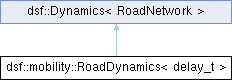
The RoadDynamics class represents the dynamics of the network. More...
#include <RoadDynamics.hpp>
Public Member Functions | |
| RoadDynamics (RoadNetwork &graph, bool useCache=false, std::optional< unsigned int > seed=std::nullopt, PathWeight const weightFunction=PathWeight::TRAVELTIME, std::optional< double > weightTreshold=std::nullopt) | |
| Construct a new RoadDynamics object. | |
| void | setErrorProbability (double errorProbability) |
| Set the error probability. | |
| void | setPassageProbability (double passageProbability) |
| Set the passage probability. | |
| void | killStagnantAgents (double timeToleranceFactor=3.) |
| Set the time tolerance factor for killing stagnant agents. An agent will be considered stagnant if it has not moved for timeToleranceFactor * std::ceil(street_length / street_maxSpeed) time units. | |
| void | setWeightFunction (PathWeight const pathWeight, std::optional< double > weightThreshold=std::nullopt) |
| Set the weight function. | |
| void | setForcePriorities (bool forcePriorities) noexcept |
| Set the force priorities flag. | |
| void | setDataUpdatePeriod (delay_t dataUpdatePeriod) noexcept |
| Set the data update period. | |
| void | setMeanTravelDistance (double const meanTravelDistance) |
| Set the mean distance travelled by a random agent. The distance will be sampled from an exponential distribution with this mean. | |
| void | setMeanTravelTime (std::time_t const meanTravelTime) noexcept |
| Set the mean travel time for random agents. The travel time will be sampled from an exponential distribution with this mean. | |
| void | setOriginNodes (std::unordered_map< Id, double > const &originNodes={}) |
| Set the origin nodes. If the provided map is empty, the origin nodes are set using the streets' stationary weights. NOTE: the default stationary weights are 1.0 so, if not set, this is equivalent to setting uniform weights. | |
| void | setDestinationNodes (std::unordered_map< Id, double > const &destinationNodes) |
| Set the destination nodes. | |
| void | setDestinationNodes (std::initializer_list< Id > destinationNodes) |
| Set the destination nodes. | |
| template<typename TContainer> | |
| void | setDestinationNodes (TContainer const &destinationNodes) |
| Set the destination nodes. | |
| virtual void | setAgentSpeed (std::unique_ptr< Agent > const &pAgent)=0 |
| void | initTurnCounts () |
| Initialize the turn counts map. | |
| void | resetTurnCounts () |
| Reset the turn counts map values to zero. | |
| void | saveData (std::time_t const savingInterval, bool const saveAverageStats=false, bool const saveStreetData=false, bool const saveTravelData=false) |
| void | updatePaths (bool const throw_on_empty=true) |
| Update the paths of the itineraries based on the given weight function. | |
| void | addAgentsUniformly (Size nAgents, std::optional< Id > itineraryId=std::nullopt) |
| Add agents uniformly on the road network. | |
| template<typename TContainer> | |
| void | addRandomAgents (std::size_t nAgents, TContainer const &spawnWeights) |
| void | addRandomAgents (std::size_t nAgents) |
| template<typename TContainer> | |
| void | addAgentsRandomly (Size nAgents, const TContainer &src_weights, const TContainer &dst_weights) |
| Add a set of agents to the simulation. | |
| void | addAgentsRandomly (Size nAgents) |
| void | addAgent (std::unique_ptr< Agent > agent) |
| Add an agent to the simulation. | |
| template<typename... TArgs> | |
| void | addAgent (TArgs &&... args) |
| template<typename... TArgs> | |
| void | addAgents (std::size_t const nAgents, TArgs &&... args) |
| template<typename... TArgs> | |
| void | addItinerary (TArgs &&... args) |
| Add an itinerary. | |
| void | addItinerary (std::shared_ptr< Itinerary > itinerary) |
| Add an itinerary. | |
| void | evolve (bool reinsert_agents=false) |
| Evolve the simulation. | |
| void | optimizeTrafficLights (TrafficLightOptimization optimizationType=TrafficLightOptimization::DOUBLE_TAIL, const std::string &logFile=std::string(), double const percentage=0.3, double const threshold=1.3) |
| Optimize the traffic lights by changing the green and red times. | |
| auto const & | itineraries () const noexcept |
| Get the itineraries. | |
| std::unordered_map< Id, double > const & | originNodes () const noexcept |
| Get the origin nodes of the graph. | |
| std::unordered_map< Id, double > & | originNodes () noexcept |
| Get the origin nodes of the graph. | |
| std::unordered_map< Id, double > const & | destinationNodes () const noexcept |
| Get the destination nodes of the graph. | |
| std::unordered_map< Id, double > & | destinationNodes () noexcept |
| Get the destination nodes of the graph. | |
| const std::vector< std::unique_ptr< Agent > > & | agents () const noexcept |
| Get the agents. | |
| Size | nAgents () const |
| Get the number of agents currently in the simulation. | |
| Measurement< double > | meanTravelTime (bool clearData=false) |
| Get the mean travel time of the agents in \(s\). | |
| Measurement< double > | meanTravelDistance (bool clearData=false) |
| Get the mean travel distance of the agents in \(m\). | |
| Measurement< double > | meanTravelSpeed (bool clearData=false) |
| Get the mean travel speed of the agents in \(m/s\). | |
| std::unordered_map< Id, std::unordered_map< Id, size_t > > const & | turnCounts () const noexcept |
| Get the turn counts of the agents. | |
| std::unordered_map< Id, std::unordered_map< Id, double > > const | normalizedTurnCounts () const noexcept |
| Get the normalized turn counts of the agents. | |
| std::unordered_map< Id, std::array< long, 4 > > | turnMapping () const |
| tbb::concurrent_unordered_map< Id, std::size_t > | originCounts (bool const bReset=true) noexcept |
| Get the origin counts of the agents. | |
| tbb::concurrent_unordered_map< Id, std::size_t > | destinationCounts (bool const bReset=true) noexcept |
| Get the destination counts of the agents. | |
| Measurement< double > | streetMeanDensity (bool normalized=false) const |
| Get the mean density of the streets in \(m^{-1}\). | |
| Measurement< double > | streetMeanFlow () const |
| Get the mean flow of the streets in \(s^{-1}\). | |
| Measurement< double > | streetMeanFlow (double threshold, bool above) const |
| Get the mean flow of the streets in \(s^{-1}\). | |
| void | summary (std::ostream &os=std::cout) const |
| Print a summary of the dynamics to an output stream. | |
| Public Member Functions inherited from dsf::Dynamics< RoadNetwork > | |
| Dynamics (RoadNetwork &graph, std::optional< unsigned int > seed=std::nullopt) | |
| Construct a new Dynamics object. | |
| void | setName (const std::string &name) |
| Set the name of the simulation. | |
| void | setInitTime (std::time_t timeEpoch) |
| Set the initial time as epoch time. | |
| void | connectDataBase (std::string const &dbPath) |
| auto const & | graph () const |
| Get the graph. | |
| auto const & | id () const |
| Get the id of the simulation. | |
| auto const & | name () const |
| Get the name of the simulation. | |
| auto const & | database () const |
| Get the database connection (const version). | |
| auto | time () const |
| Get the current simulation time as epoch time. | |
| auto | time_step () const |
| Get the current simulation time-step. | |
| auto | strDateTime () const |
| Get the current simulation time as formatted string (YYYY-MM-DD HH:MM:SS). | |
Protected Attributes | |
| std::unordered_map< Id, std::unordered_map< Id, size_t > > | m_turnCounts |
| std::unordered_map< Id, std::array< long, 4 > > | m_turnMapping |
| tbb::concurrent_unordered_map< Id, std::unordered_map< Direction, double > > | m_queuesAtTrafficLights |
| tbb::concurrent_vector< std::pair< double, double > > | m_travelDTs |
| std::time_t | m_previousOptimizationTime {0} |
| std::function< double(std::unique_ptr< Street > const &)> | m_weightFunction |
| std::optional< double > | m_errorProbability {std::nullopt} |
| std::optional< double > | m_passageProbability {std::nullopt} |
| std::optional< double > | m_meanTravelDistance {std::nullopt} |
| std::optional< std::time_t > | m_meanTravelTime {std::nullopt} |
| std::optional< delay_t > | m_dataUpdatePeriod |
| bool | m_bCacheEnabled |
| PathWeight | m_pathWeight = PathWeight::TRAVELTIME |
| double | m_weightTreshold |
| std::optional< double > | m_timeToleranceFactor {std::nullopt} |
| bool | m_forcePriorities {false} |
| std::time_t | m_savingInterval {0} |
| bool | m_bSaveStreetData {false} |
| bool | m_bSaveTravelData {false} |
| bool | m_bSaveAverageStats {false} |
| Protected Attributes inherited from dsf::Dynamics< RoadNetwork > | |
| tbb::task_arena | m_taskArena |
| std::mt19937_64 | m_generator |
Additional Inherited Members | |
| Protected Member Functions inherited from dsf::Dynamics< RoadNetwork > | |
| void | m_evolve () |
| auto | m_safeDateTime () const |
| Get a safe date-time string for filenames (YYYYMMDD_HHMMSS). | |
| auto | m_safeName () const |
| Get a safe name string for filenames (spaces replaced by underscores). | |
Detailed Description
requires (is_numeric_v<delay_t>)
class dsf::mobility::RoadDynamics< delay_t >
The RoadDynamics class represents the dynamics of the network.
- Template Parameters
-
delay_t The type of the agent's delay
Constructor & Destructor Documentation
◆ RoadDynamics()
| dsf::mobility::RoadDynamics< delay_t >::RoadDynamics | ( | RoadNetwork & | graph, |
| bool | useCache = false, | ||
| std::optional< unsigned int > | seed = std::nullopt, | ||
| PathWeight const | weightFunction = PathWeight::TRAVELTIME, | ||
| std::optional< double > | weightTreshold = std::nullopt ) |
Construct a new RoadDynamics object.
- Parameters
-
graph The graph representing the network useCache If true, the cache is used (default is false) seed The seed for the random number generator (default is std::nullopt) weightFunction The dsf::PathWeight function to use for the pathfinding (default is dsf::PathWeight::TRAVELTIME) weightTreshold The weight treshold for updating the paths (default is std::nullopt)
Member Function Documentation
◆ addAgent()
| void dsf::mobility::RoadDynamics< delay_t >::addAgent | ( | std::unique_ptr< Agent > | agent | ) |
Add an agent to the simulation.
- Parameters
-
agent std::unique_ptr to the agent
◆ addAgentsRandomly()
| void dsf::mobility::RoadDynamics< delay_t >::addAgentsRandomly | ( | Size | nAgents, |
| const TContainer & | src_weights, | ||
| const TContainer & | dst_weights ) |
Add a set of agents to the simulation.
- Parameters
-
nAgents The number of agents to add src_weights The weights of the source nodes dst_weights The weights of the destination nodes
- Exceptions
-
std::invalid_argument If the source and destination nodes are the same
◆ addAgentsUniformly()
| void dsf::mobility::RoadDynamics< delay_t >::addAgentsUniformly | ( | Size | nAgents, |
| std::optional< Id > | itineraryId = std::nullopt ) |
Add agents uniformly on the road network.
- Parameters
-
nAgents The number of agents to add itineraryId The id of the itinerary to use (default is std::nullopt)
- Exceptions
-
std::runtime_error If there are no itineraries
◆ addItinerary() [1/2]
| void dsf::mobility::RoadDynamics< delay_t >::addItinerary | ( | std::shared_ptr< Itinerary > | itinerary | ) |
Add an itinerary.
- Parameters
-
itinerary std::unique_ptr to the itinerary
- Exceptions
-
std::invalid_argument If the itinerary already exists std::invalid_argument If the itinerary's destination is not a node of the graph
◆ addItinerary() [2/2]
| void dsf::mobility::RoadDynamics< delay_t >::addItinerary | ( | TArgs &&... | args | ) |
Add an itinerary.
- Parameters
-
...args The arguments to construct the itinerary
The arguments must be compatible with any constructor of the Itinerary class
◆ agents()
|
inlinenoexcept |
Get the agents.
- Returns
- const std::unordered_map<Id, Agent<Id>>&, The agents
◆ destinationCounts()
|
noexcept |
Get the destination counts of the agents.
- Parameters
-
bReset If true, the destination counts are cleared (default is true)
◆ destinationNodes() [1/2]
|
inlinenoexcept |
Get the destination nodes of the graph.
- Returns
- std::unordered_map<Id, double> const& The destination nodes of the graph
◆ destinationNodes() [2/2]
|
inlinenoexcept |
Get the destination nodes of the graph.
- Returns
- std::unordered_map<Id, double>& The destination nodes of the graph
◆ evolve()
| void dsf::mobility::RoadDynamics< delay_t >::evolve | ( | bool | reinsert_agents = false | ) |
Evolve the simulation.
Evolve the simulation by moving the agents and updating the travel times. In particular:
- Move the first agent of each street queue, if possible, putting it in the next node
- Move the agents from each node, if possible, putting them in the next street and giving them a speed. If the error probability is not zero, the agents can move to a random street. If the agent is in the destination node, it is removed from the simulation (and then reinserted if reinsert_agents is true)
- Cycle over agents and update their times
- Parameters
-
reinsert_agents If true, the agents are reinserted in the simulation after they reach their destination
◆ initTurnCounts()
| void dsf::mobility::RoadDynamics< delay_t >::initTurnCounts | ( | ) |
Initialize the turn counts map.
- Exceptions
-
std::runtime_error if the turn counts map is already initialized
◆ itineraries()
|
inlinenoexcept |
Get the itineraries.
- Returns
- const std::unordered_map<Id, Itinerary>&, The itineraries
◆ killStagnantAgents()
| void dsf::mobility::RoadDynamics< delay_t >::killStagnantAgents | ( | double | timeToleranceFactor = 3. | ) |
Set the time tolerance factor for killing stagnant agents. An agent will be considered stagnant if it has not moved for timeToleranceFactor * std::ceil(street_length / street_maxSpeed) time units.
- Parameters
-
timeToleranceFactor The time tolerance factor
- Exceptions
-
std::invalid_argument If the time tolerance factor is not positive
◆ meanTravelDistance()
| Measurement< double > dsf::mobility::RoadDynamics< delay_t >::meanTravelDistance | ( | bool | clearData = false | ) |
Get the mean travel distance of the agents in \(m\).
- Parameters
-
clearData If true, the travel distances are cleared after the computation
- Returns
- Measurement<double> The mean travel distance of the agents and the standard deviation
◆ meanTravelSpeed()
| Measurement< double > dsf::mobility::RoadDynamics< delay_t >::meanTravelSpeed | ( | bool | clearData = false | ) |
Get the mean travel speed of the agents in \(m/s\).
- Parameters
-
clearData If true, the travel times and distances are cleared after the computation
- Returns
- Measurement<double> The mean travel speed of the agents and the standard deviation
◆ meanTravelTime()
| Measurement< double > dsf::mobility::RoadDynamics< delay_t >::meanTravelTime | ( | bool | clearData = false | ) |
Get the mean travel time of the agents in \(s\).
- Parameters
-
clearData If true, the travel times are cleared after the computation
- Returns
- Measurement<double> The mean travel time of the agents and the standard deviation
◆ nAgents()
| Size dsf::mobility::RoadDynamics< delay_t >::nAgents | ( | ) | const |
Get the number of agents currently in the simulation.
- Returns
- Size The number of agents
◆ normalizedTurnCounts()
|
noexcept |
Get the normalized turn counts of the agents.
- Returns
- const std::unordered_map<Id, std::unordered_map<Id, double>>& The normalized turn counts. The outer map's key is the street id, the inner map's key is the next street id and the value is the normalized number of counts
◆ optimizeTrafficLights()
| void dsf::mobility::RoadDynamics< delay_t >::optimizeTrafficLights | ( | TrafficLightOptimization | optimizationType = TrafficLightOptimization::DOUBLE_TAIL, |
| const std::string & | logFile = std::string(), | ||
| double const | percentage = 0.3, | ||
| double const | threshold = 1.3 ) |
Optimize the traffic lights by changing the green and red times.
- Parameters
-
optimizationType TrafficLightOptimization, The type of optimization. Default is DOUBLE_TAIL logFile The file into which write the logs (default is empty, meaning no logging) percentage double, the maximum amount (percentage) of the green time to change (default is 0.3) threshold double, The ratio between the self-density and neighbour density to trigger the non-local optimization (default is 1.3)
The local optimization is done by changing the green time of each traffic light, trying to make it proportional to the queue lengths at each phase. The non-local optimization is done by synchronizing the traffic lights which are congested over threshold.
◆ originCounts()
|
noexcept |
Get the origin counts of the agents.
- Parameters
-
bReset If true, the origin counts are cleared (default is true)
◆ originNodes() [1/2]
|
inlinenoexcept |
Get the origin nodes of the graph.
- Returns
- std::unordered_map<Id, double> const& The origin nodes of the graph
◆ originNodes() [2/2]
|
inlinenoexcept |
Get the origin nodes of the graph.
- Returns
- std::unordered_map<Id, double>& The origin nodes of the graph
◆ resetTurnCounts()
| void dsf::mobility::RoadDynamics< delay_t >::resetTurnCounts | ( | ) |
Reset the turn counts map values to zero.
- Exceptions
-
std::runtime_error if the turn counts map is not initialized
◆ setAgentSpeed()
|
pure virtual |
Implemented in dsf::mobility::FirstOrderDynamics.
◆ setDataUpdatePeriod()
|
inlinenoexcept |
Set the data update period.
- Parameters
-
dataUpdatePeriod delay_t, The period
Some data, i.e. the street queue lengths, are stored only after a fixed amount of time which is represented by this variable.
◆ setDestinationNodes() [1/3]
| void dsf::mobility::RoadDynamics< delay_t >::setDestinationNodes | ( | std::initializer_list< Id > | destinationNodes | ) |
Set the destination nodes.
- Parameters
-
destinationNodes The destination nodes (as an initializer list)
◆ setDestinationNodes() [2/3]
| void dsf::mobility::RoadDynamics< delay_t >::setDestinationNodes | ( | std::unordered_map< Id, double > const & | destinationNodes | ) |
Set the destination nodes.
- Parameters
-
destinationNodes The destination nodes
◆ setDestinationNodes() [3/3]
| void dsf::mobility::RoadDynamics< delay_t >::setDestinationNodes | ( | TContainer const & | destinationNodes | ) |
Set the destination nodes.
- Parameters
-
destinationNodes A container of destination nodes ids
The container must have a value_type convertible to Id and begin() and end() methods
◆ setErrorProbability()
| void dsf::mobility::RoadDynamics< delay_t >::setErrorProbability | ( | double | errorProbability | ) |
Set the error probability.
- Parameters
-
errorProbability The error probability
- Exceptions
-
std::invalid_argument If the error probability is not between 0 and 1
◆ setForcePriorities()
|
inlinenoexcept |
Set the force priorities flag.
- Parameters
-
forcePriorities The flag
If true, if an agent cannot move to the next street, the whole node is skipped
◆ setMeanTravelDistance()
|
inline |
Set the mean distance travelled by a random agent. The distance will be sampled from an exponential distribution with this mean.
- Parameters
-
meanTravelDistance The mean distance
- Exceptions
-
std::invalid_argument If the mean distance is negative
◆ setMeanTravelTime()
|
inlinenoexcept |
Set the mean travel time for random agents. The travel time will be sampled from an exponential distribution with this mean.
- Parameters
-
meanTravelTime The mean travel time
◆ setOriginNodes()
| void dsf::mobility::RoadDynamics< delay_t >::setOriginNodes | ( | std::unordered_map< Id, double > const & | originNodes = {} | ) |
Set the origin nodes. If the provided map is empty, the origin nodes are set using the streets' stationary weights. NOTE: the default stationary weights are 1.0 so, if not set, this is equivalent to setting uniform weights.
- Parameters
-
originNodes The origin nodes
◆ setPassageProbability()
| void dsf::mobility::RoadDynamics< delay_t >::setPassageProbability | ( | double | passageProbability | ) |
Set the passage probability.
- Parameters
-
passageProbability The passage probability
The passage probability is the probability of passing through a node It is useful in the case of random agents
◆ setWeightFunction()
| void dsf::mobility::RoadDynamics< delay_t >::setWeightFunction | ( | PathWeight const | pathWeight, |
| std::optional< double > | weightThreshold = std::nullopt ) |
Set the weight function.
- Parameters
-
pathWeight The dsf::PathWeight function to use for the pathfinding weightThreshold The weight threshold for updating the paths (default is std::nullopt)
◆ streetMeanDensity()
| Measurement< double > dsf::mobility::RoadDynamics< delay_t >::streetMeanDensity | ( | bool | normalized = false | ) | const |
Get the mean density of the streets in \(m^{-1}\).
- Returns
- Measurement<double> The mean density of the streets and the standard deviation
◆ streetMeanFlow() [1/2]
| Measurement< double > dsf::mobility::RoadDynamics< delay_t >::streetMeanFlow | ( | ) | const |
Get the mean flow of the streets in \(s^{-1}\).
- Returns
- Measurement<double> The mean flow of the streets and the standard deviation
◆ streetMeanFlow() [2/2]
| Measurement< double > dsf::mobility::RoadDynamics< delay_t >::streetMeanFlow | ( | double | threshold, |
| bool | above ) const |
Get the mean flow of the streets in \(s^{-1}\).
- Parameters
-
threshold The density threshold to consider above If true, the function returns the mean flow of the streets with a density above the threshold, otherwise below
- Returns
- Measurement<double> The mean flow of the streets and the standard deviation
◆ summary()
| void dsf::mobility::RoadDynamics< delay_t >::summary | ( | std::ostream & | os = std::cout | ) | const |
Print a summary of the dynamics to an output stream.
- Parameters
-
os The output stream to write to (default is std::cout)
The summary includes:
- The RoadNetwork description (nodes, edges, capacity, intersections, traffic lights, roundabouts, coil sensors)
- Number of inserted agents
- Number of added agents
- Number of arrived agents
- Number of killed agents
- Current number of agents in the simulation
◆ turnCounts()
|
inlinenoexcept |
Get the turn counts of the agents.
- Returns
- const std::unordered_map<Id, std::unordered_map<Id, size_t>>& The turn counts. The outer map's key is the street id, the inner map's key is the next street id and the value is the number of counts
◆ updatePaths()
| void dsf::mobility::RoadDynamics< delay_t >::updatePaths | ( | bool const | throw_on_empty = true | ) |
Update the paths of the itineraries based on the given weight function.
- Parameters
-
throw_on_empty If true, throws an exception if an itinerary has an empty path (default is true) If false, removes the itinerary with empty paths and the associated node from the origin/destination nodes
- Exceptions
-
std::runtime_error if throw_on_empty is true and an itinerary has an empty path
The documentation for this class was generated from the following file:
- src/dsf/mobility/RoadDynamics.hpp